Case study — Delta · Accessible Travel Services
From “Special” to Standard
How language, systems, and assumptions shape the experience of disabled air travelers — and what it takes to surface the patterns that make individual fixes actually stick.
A team ready to act
Context and positionality
In 2019, Delta Air Lines was ready to take a harder look at how it served disabled travelers. The Accessible Travel Services redesign — part of the larger 2018–2021 AKQA and Delta engagement — came out of that readiness: a service team with enough institutional trust, and enough internal frustration with the status quo, to actually want the research to land somewhere. That's not a given. A lot of accessibility work happens inside organizations that are defensive about it, where research documents compliance rather than drives change. This wasn't that. The team was open, and they had a head start — an existing FAA disability complaints dataset that gave us a quantitative baseline before we ran a single interview.
I came into this project as a dynamically disabled person who sometimes travels with a mobility aid. That's an epistemological position, not a disclosure. Insider knowledge in this domain isn't incidental — it changes what you notice, what you ask, and what feels worth following. I already knew the texture of the planning overhead: the pre-call to confirm the wheelchair assist is booked, the way you hold your breath at the jetbridge, the calculation of how much energy to spend advocating versus just getting on the plane. That knowledge sharpened my research questions. It also created an obligation to hold it carefully — to know when my experience was a useful prior and when it was a blind spot.
Lived experience is a foundation, not a substitute for field work.
I knew some of what disabled travelers were dealing with because I'm one of them. I didn't know all of it, and I especially didn't know how it was distributed across the range of disability experience — physical, sensory, cognitive, fluctuating, invisible. The research had to hold both: the sharper questions insider knowledge made possible, and the discipline of testing those questions against a range of experience much wider than my own. Trust the pattern when the pattern is real; probe harder when your own experience is too narrow to generalize from.
Where you recruit is where the research lives or dies
Research approach
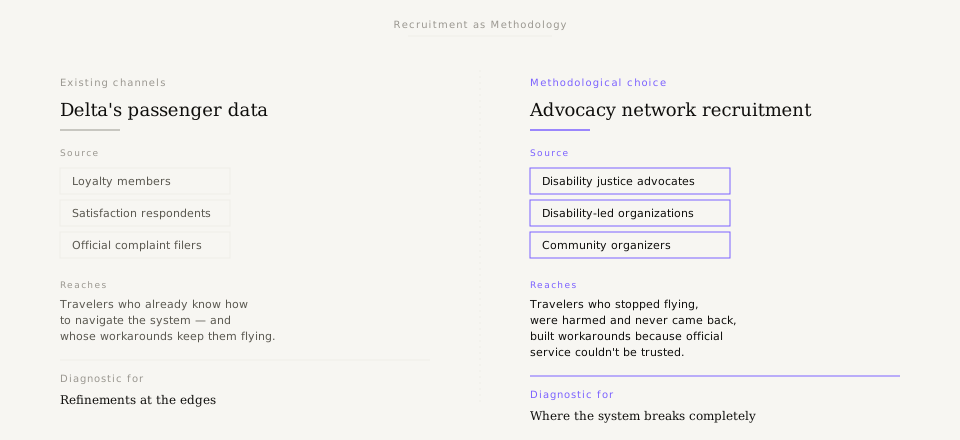
The first real decision — the one that shaped everything else — was where to recruit. Delta had passenger channels: satisfaction survey respondents, loyalty program members, people who had filed complaints officially. Those populations would have given me travelers who already knew how to navigate the system — people who had found the accommodations form, who knew to call ahead, who had developed workarounds good enough to keep flying Delta. Their experience was real and it mattered. But they weren't the most diagnostic participants for a project about where the system was broken.
I recruited primarily through disability justice advocates and disability-led organizations. That decision let me reach people who had stopped flying, who had been harmed during a trip and never come back, who had built elaborate informal workarounds because the official service wasn't trustworthy enough to rely on. Those participants had the clearest view of the system's failure modes — not because they were more vocal or more organized, but because the system's gaps had cost them something. The advocates also helped me reach people across a much wider range of disability experience than Delta's own channels would have surfaced.
The broader frame I kept in front of me: this research was operating inside the accessible travel fight, not adjacent to it. Disabled travelers have been pushing for basic dignity in air travel for decades — through litigation, through advocacy, through the Air Carrier Access Act and its many failures to be enforced. I wasn't researching a service problem in isolation. I was researching inside a system with a history. A pre-research listening tour shaped this study before a single interview guide was written.
Four methods, designed to triangulate
Methods
Each method made something different visible. None was sufficient alone. The convergence between them is what made the findings strong enough to act on.
Service observations at airports
Time in airports watching the service as delivered rather than the service as designed — the gap between those two is where the most interesting research questions live. Operational pressure is invisible in a service blueprint; in physical space it looks like a gate agent managing three competing demands at once, a wheelchair assist arriving fifteen minutes late because the request was entered incorrectly at booking, a jetbridge handoff nobody owns clearly. Observation showed me where the design broke down under real conditions, and what staff actually reached for in those moments.
Frontline staff interviews
Some of the most useful data I collected, and easy to skip in accessibility research because the traveler experience feels more central. Staff interviews gave me the internal texture of a broken system. Staff weren't failing because they didn't care — they were in situations the training hadn't prepared them for. Not knowledge gaps: situational ambiguity. They knew the standard protocol; they didn't know what to do when the situation was non-standard and there was no time to find out. Several described feeling caught between what policy said and what the passenger in front of them needed, with no good path through. That's a system problem, not a training problem.
Diary studies
Single-session research captures a moment. Accessible travel is an arc — booking, preparation, the airport, the flight, arrival, and the recovery afterward. Diary studies captured the full arc, which meant capturing what's nearly invisible in other methods: the cognitive overhead of planning an accessible trip, the emotional tone of arriving at the airport having already spent energy on logistics, the cumulative effect of small frictions across a multi-leg journey. Participants logged entries at their own pace, so the data was closer to real-time than retrospective recall.
Traveler interviews, in-person and remote
The core qualitative data. I interviewed across a wide range of disability experience: ambulatory wheelchair users, people with chronic illness, Deaf and hard-of-hearing travelers, people with cognitive disabilities, people with fluctuating or invisible conditions who didn't always read as disabled to staff. That range mattered because the failure modes differed — a policy that worked for one population was actively harmful for another. Remote was the default: participants in wheelchairs or with fatigue-related conditions shouldn't have to get themselves to a research facility to tell me about a service that's already inaccessible. What remote lost in environmental context, the service observations gave back.
One word, three data sources, same pattern
The pivotal finding
The language finding emerged from cross-method triangulation, which is part of why it was strong enough to bring to leadership. It started in the diary studies: multiple participants used the word “special” when describing the Accessible Travel Services program, and the emotional valence was consistently negative. Not “I felt cared for.” More like “I felt like a special case.” Special as marked, exceptional, separated from the normal flow of being a customer.
The pattern got stronger in the traveler interviews. Participants described the service as something that happened to them rather than something they were included in — an administrative burden that flagged them as different, not an accommodation that let them travel on equal terms. The language wasn't incidental. It was doing real work in how people interpreted the service and their relationship to it.
Then, in a staff interview, a frontline employee described their own experience of running the program in the same terms.
Like I'm running a special program.
Frontline employee — same word as the travelers, different vantage point, same underlying structure

That convergence is what made the insight actionable. The rebrand from “Special Travel Services” to “Accessible Travel Services” wasn't cosmetic — it signaled that the system's baseline assumption about who a normal traveler was had shifted.
The word “accessible” puts the modifier on the service, not on the traveler. That's a different theory of the relationship.
Two outcomes — and a methodology lesson
What the research made possible
The immediate outcomes were concrete. The rebrand went forward — a decision that required leadership alignment across multiple functions, which the convergent research made possible because the evidence wasn't coming from a single data point or a single participant type.
The training redesign was the other significant outcome, shaped by what the staff interviews actually showed. The gap wasn't knowledge — staff knew the accommodation protocols. The gap was situational: they had no frameworks for adapting when the situation was non-standard and time pressure was real. The new training focused on decision-making under ambiguity rather than protocol recall — a different intervention than the team had originally assumed was needed.